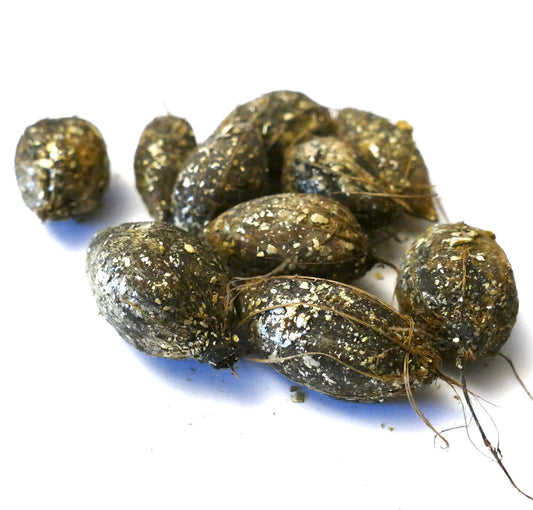
Barringtonia Seeds: Riverside Trees with Hanging Racemes of Brush Flowers
Barringtonia brings together around 70 species of shrubs and trees of the Brazil-nut family, Lecythidaceae, ranging from eastern Africa and Madagascar through tropical Asia to northern Australia and the islands of the Pacific. Most grow close to water: on beaches and mangrove margins, along riverbanks and in freshwater swamp forest. The leaves are crowded towards the ends of the branches, and the flowers are carried on racemes or spikes that in many species hang well below the foliage. Each flower has four small petals almost hidden by a brush of long stamens. The fruits are fibrous and usually one-seeded, and it is these large seeds that are offered as Barringtonia seeds.
Barringtonia macrocarpa
Barringtonia macrocarpa is native from Myanmar, Thailand and Vietnam south to Peninsular Malaysia, Sumatra, Java and Borneo, where it grows along rivers, in swampy forest and on ground that is periodically flooded, from sea level to about 300 m. It is usually described as a shrub or small tree of 1.5–6 m, occasionally 13 m, though some accounts record considerably taller specimens. The leaves are very large — narrowly obovate, 30–60 cm long, finely toothed and almost stalkless — and gathered at the branch tips. From among them hang the racemes, recorded at anything from 26 cm to more than a metre in length and carrying up to 135 flowers, with white or pale pink petals, pink to purple sepals and pink stamens 3–4 cm long. The fruit is obovoid to oblong, with three or four angles or narrow wings, and holds a single large seed.
Fish Poisons and Floating Fruit
Barringtonia asiatica, the sea poison tree of Indo-Pacific shores, and B. racemosa, the powder-puff tree, both have buoyant, fibrous fruits that travel by water. Their seeds and bark contain saponins and have long been used to stupefy fish in pools and slow streams. B. macrocarpa shares this history: in Java and Borneo the pounded roots or root bark served as a fish poison, while in Java the young shoots are eaten raw as a salad vegetable. The seeds themselves should be regarded as toxic and never eaten.
Sowing Barringtonia Seeds
Barringtonia seed is recalcitrant — this is documented for B. racemosa and should be assumed for its relatives — which means that it has no dormancy, cannot be dried and cannot be stored. Sow it as soon as it arrives. Set the seed 3–5 cm deep in a humus-rich mix that holds plenty of moisture; if it is not clear which end is the base, lay it on its side and half-bury it. Keep the pot at 25–30°C in bright shade and never let it dry out: these are plants of flooded ground. In B. racemosa the first roots can appear within a week or two, although seed sown inside the whole fruit may take two to three months. No figures have been published for B. macrocarpa itself, so allow a similar span. Seedlings need warmth and humidity all year and have no tolerance of frost.
Bold foliage, long hanging racemes and a liking for wet ground make Barringtonia seeds a rewarding choice for the tropical water garden or the warm glasshouse collection.
- Around 70 species from eastern Africa to the Pacific, in the Brazil-nut family
- Barringtonia macrocarpa: Myanmar and Vietnam to Borneo and Java
- Leaves 30–60 cm long; pendulous racemes to over a metre
- Recalcitrant seed: sow on arrival and never let it dry
- 25–30°C, shade and constant moisture; no frost