
Jacaranda
-
Jacaranda mimosifolia
Regular price From €18,00 EURRegular price

Collection: Jacaranda
Discover the Elegance of Jacaranda Trees
Jacaranda: A Flowering Beauty
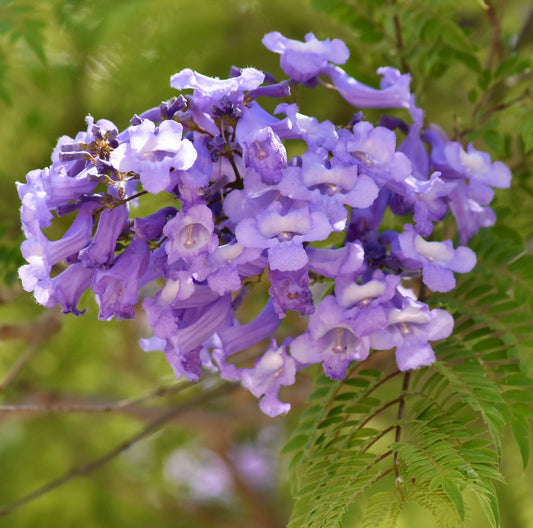
The Jacaranda tree, known for its vibrant purple flowers, is a stunning addition to any landscape. Popular varieties like the Jacaranda Mimosifolia bring elegance and a tropical touch to gardens and urban spaces.
Native to South America, particularly Brazil and Argentina, the Jacaranda belongs to the Bignoniaceae family and is widely celebrated for its spectacular canopy of trumpet-shaped, lavender-blue blooms that appear in late spring to early summer. These ethereal flowers often blanket the ground beneath in a carpet of soft color, creating a dreamlike atmosphere. Its fern-like, bipinnate foliage adds a delicate texture that contrasts beautifully with the structural elegance of its branches, offering year-round appeal even outside the blooming season.
This semi-deciduous tree can reach heights of up to 12–15 meters (40–50 feet), making it a graceful, arching presence in both wide open spaces and along boulevards. In many parts of the world—from Pretoria to Los Angeles—the Jacaranda has become a symbol of the arrival of warmer seasons, celebrated in public gardens and cityscapes alike.

Caring for Jacaranda Trees
Jacaranda trees thrive in warm climates with well-drained soil and full sunlight. With minimal maintenance and occasional pruning, these trees reward gardeners with breathtaking seasonal blooms.
To grow successfully, they need at least 6–8 hours of sunlight per day and prefer sandy or loamy soils that drain quickly but retain some organic matter. When young, they benefit from consistent watering to establish deep roots, but once mature, they become moderately drought-tolerant and low-maintenance.
Fertilizing lightly in early spring with a balanced formula can encourage healthy foliage and flower production. While the Jacaranda rarely suffers from serious pest infestations, light pruning after flowering can help maintain shape and remove dead or weak limbs, ensuring air circulation within the canopy.
In frost-prone regions, protection is required during the first few years of growth, as this species is sensitive to prolonged cold. However, in zones with mild winters and hot summers, it flourishes, often becoming the centerpiece of parks, avenues, and gardens thanks to its reliable blooming cycle and fast growth.

Why Choose a Jacaranda for Your Garden
Perfect for creating a focal point, Jacarandas provide shade and visual appeal. Their adaptability makes them suitable for residential and commercial landscapes, adding charm and color.
The umbrella-like crown offers generous shade during the hottest months, making it a practical as well as ornamental choice. In large gardens, it becomes a showpiece tree that draws the eye upward, while in more structured designs, it softens hardscapes and provides a seasonal spectacle with minimal care requirements.
Urban planners often favor the species for its tolerance to air pollution and its ability to thrive in tough city environments—lining streets, civic squares, and university campuses with sweeping floral displays. Home gardeners appreciate the Jacaranda’s graceful silhouette and feathery foliage, which casts dappled shadows that support an understory of shade-tolerant perennials or groundcovers.
Even as a young sapling, it adds elegance to modern, Mediterranean, and tropical-style landscapes alike. With time, it transforms into a living landmark—one that brings beauty, biodiversity, and tranquility to any setting it inhabits.
Popular Varieties of Jacaranda
From the classic Blue Jacaranda to the unique Pink Jacaranda, each variety offers something special. These trees are ideal for those looking to enhance their outdoor spaces with natural beauty.
The most widely cultivated species is Jacaranda mimosifolia, admired for its fast growth and prolific blooming. Its brilliant lavender-blue flowers remain unmatched in intensity and duration. Less common but equally impressive is Jacaranda jasminoides, a more compact form suitable for smaller spaces or container growing, especially in subtropical climates.
A true rarity is the Pink Jacaranda (Stereospermum kunthianum), which technically belongs to a closely related genus but is often grouped with Jacarandas for its similar appearance and floral display. Its blush-pink flowers offer a softer palette, ideal for garden designs seeking pastel tones and refined contrasts.
In some regions, hybrid forms have emerged—offering slight variations in flower size, color depth, and foliage density. These cultivars continue to be explored by collectors and botanical enthusiasts who value not only the visual impact of these trees, but also their legacy as ornamental icons across continents.
Other Collections in the Archive
-

Specimen Plants
Specimen Plants in our Store Specimen Plants captivate plant enthusiasts with their...
-
Catalogue Plants
Catalogue plants provide a wide variety of options to elevate your garden...
-

Gardening Tools & Soils
Gardening tools – essentials for healthy soils and thriving plants Building a...


